
Product Development
FROM AN IDEATO A FINISHED PRODUCT
You don't have to speak engineering to get this built. Tell us the problem and your constraints, and we'll take it from an idea to a fully-fledged product that you can mass deploy. You'll be involved in every big decision, so you end up with exactly what you need.
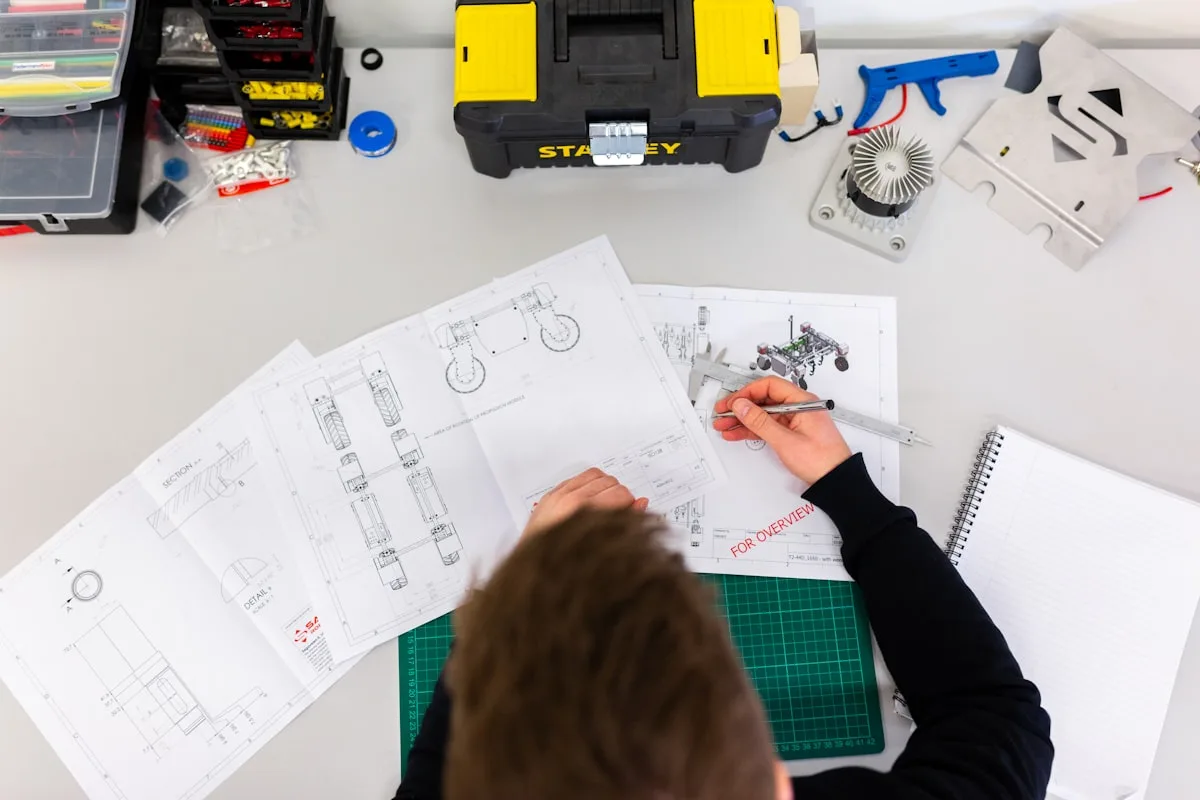
One Development Process
Four phases, and at the end of each one there is a decision that belongs to you. Below is what actually happens in each, and what it costs to change your mind once it has passed.
Requirements & Planning
First, whether the thing can be built at all. Then what parts exist to build it from, and what the place it lives in will do to it. Heat, dust, water, vibration. By a wide margin, this is the cheapest phase to change your mind in.
Schematic & Layout
The circuit gets drawn, then laid out as a physical board. The enclosure is designed around it at the same time, because a board that fits nothing is not a product. Changes are still inexpensive here. They stop being inexpensive after this.
Rapid Prototyping
We build real units and then try to break them, with whatever the deployment will throw at them. This is where you hold the thing and tell us what is wrong with it. It is also the last phase in which that conversation is cheap.
Mass Production
The design goes to volume. Tooling gets committed. Boards are inspected by machine now, not by eye, and the unit cost stops moving. A change at this point means new tooling and a new schedule, so it is a real decision.
The code that runs on the board is written while the board is being designed, not afterwards. Which phase it starts in depends on the project. If your deployment already dictates a protocol or a security standard, we build to it. You should not have to reshape your systems to accommodate our firmware.
This is the last phase, and it also runs through all four. Whether the hardware ends up talking properly to the systems you already have is what decides if the project was worth doing, so it shapes the requirements back in phase 01 instead of being solved at the end. Your software team is in this alongside ours, and the work does not stop when the units ship.
Core Capabilities
What sits inside that process, and the one place where a partner takes over.
PCB Layout & Design
Designing the board so its signals stay clean when it is bolted up next to a motor or a generator. Dense layouts across multiple layers, which is what lets a board get small without getting unreliable.
Embedded Systems
The layer that sets how much power a unit draws and how fast it reacts. It is the reason a battery device can sit out in a field for a season instead of a week.
Industrial Enclosures
The case, designed for where the unit actually goes. Sealed against water and dust, and built to take a knock. Most hardware dies of its environment long before its circuitry gives up.
Assembly & Prototyping
We populate boards ourselves for prototypes and short runs, so a revision takes days instead of weeks. Large volumes go to partner lines with our quality control on them. This is the one step we do not keep in-house at scale, and telling you otherwise would cost you schedule.
Firmware
The code on the device itself. It reads the sensors and works out on the spot what is worth sending onward, which is what keeps bandwidth and battery cost down. Written for your board, not ported onto it.
Integration
Wiring the hardware into the software you already run, with your team in the room. We scope this per project and say so up front. A fixed integration promise from a vendor who has not seen your stack is worth nothing.
Your turn
READY TO DEPLOY?
Whether you need a turnkey system or a scalable hardware ecosystem, our engineers are ready to deliver.
Expertise FAQs
Do you design your own printed circuit boards (PCBs)?
Yes, in-house. That is rather the point: the board gets designed around the product, instead of the product being bent to fit a board somebody else already made.
Do you sell software development on its own?
No. We build products, and code is part of building them. Firmware is written for the board it runs on. Anything above that is integration work, done with your software team. If what you need is an app or a platform and there is no hardware in it, we are the wrong company for you.
Can your systems integrate with our existing infrastructure?
Usually yes, and that is phase 05. We work with your software team on the protocols and on how the data is shaped, then agree the scope once we have seen what you actually run. Anyone who promises you integration before looking at your stack is guessing.
How do you handle mass production?
Once a prototype survives field testing, the design moves into volume manufacturing. We manage the supply chain and the quality control across that transition, which is the stage where most hardware projects quietly come apart.